Sexual Health Market Trends 2026: Sales Growth, Retailer Share, and Top Product Categories

Published
Sep 10, 2026
Last updated
September 24, 2026

This article breaks down sexual health market trends from January 2024 through April 2026, using retail data to track sales growth, product shifts, and retailer share changes. Findings show the market returning to growth after a 2024 slowdown, led by direct sexual wellness products like water-based lubricants. It also compares retailer share across Amazon, CVS, Walmart, Walgreens, and Target, and how brand concentration differs between Amazon's marketplace and traditional retail.
Key Takeaways
- The U.S. sexual health market returned to growth in 2026, with T12M sales rising from $1.4B to $1.5B (+5.7%) after a slowdown from mid-2024 through early 2025.
- Direct sexual wellness products (condoms, lubricants, sex toys) grew to ~72% of category sales, gaining 1.9ppt, while diagnostics (pregnancy tests, fertility trackers) lost 2.5ppt.
- Water-based lubricants were the fastest-growing major product type, up 23% and reaching $246M in T12M sales, surpassing both condoms and pregnancy tests.
- Amazon 3P captured nearly half of category retail sales, gaining 7.3ppt of share since Jan '24 and outsizing every other retailer by more than 4x.
The Sexual Health Market Returned to Growth Following a 2024 Slowdown
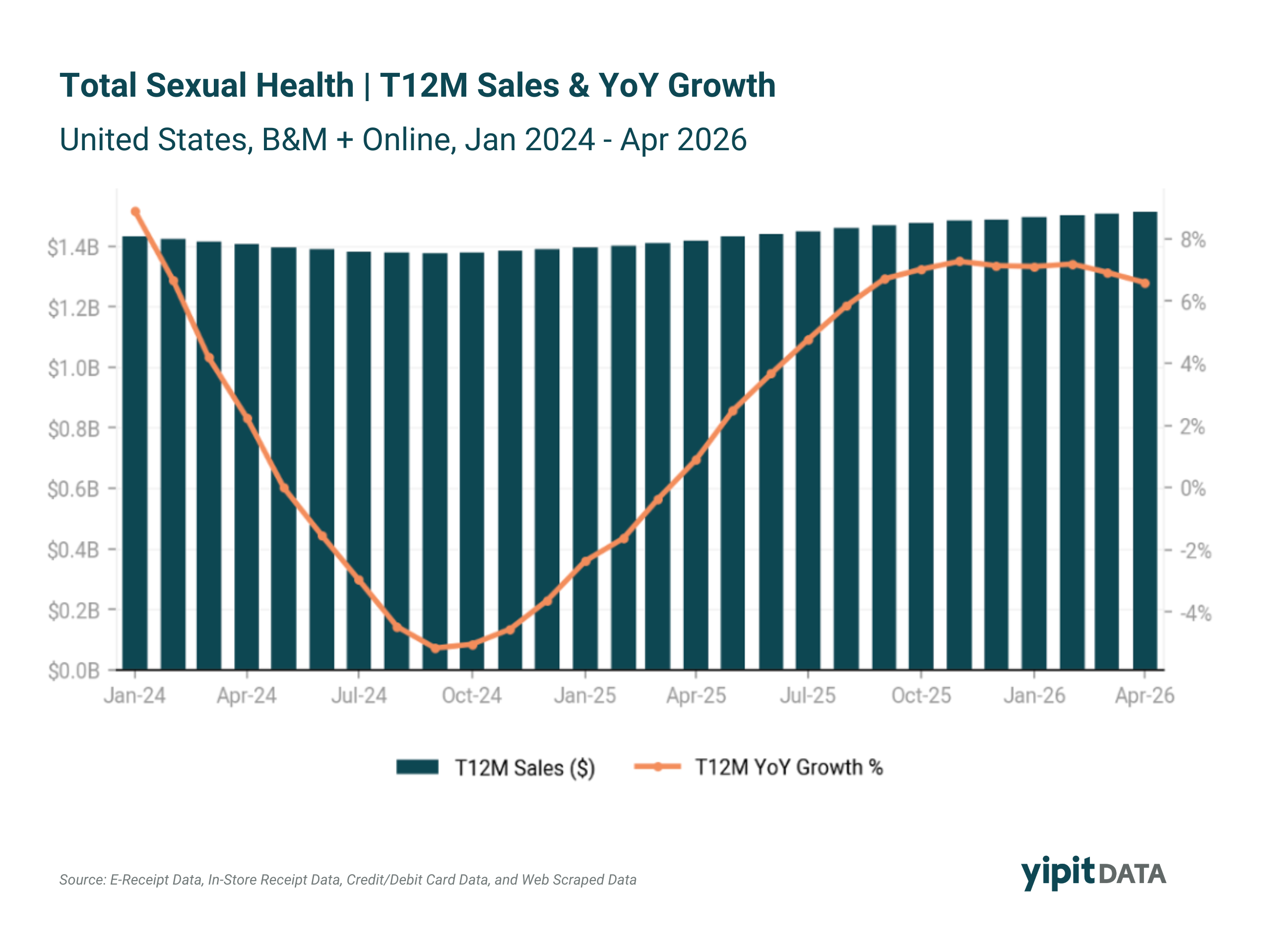
Total trailing-twelve-month (T12M) sales in the U.S. sexual health category increased from $1.4 billion to $1.5 billion between January 2024 and April 2026, a gain of 5.7%. The category posted negative year-over-year (YoY) growth from May 2024 through March 2025 before returning to sustained positive growth in April 2025. Growth stabilized through early 2026, with the category ending April 2026 at +6.6% YoY.
Direct Sexual Wellness Remained the Largest Segment of the Category
Segment-level data shows direct sexual wellness products, including condoms, lubricants, sex toys, and related accessories, expanded their share of category sales by 1.9 percentage points (ppt) over the report window, reaching approximately 72% of total sexual health sales by April 2026. Diagnostics products, such as pregnancy tests and fertility trackers, lost 2.5ppt of mix share and remained slightly negative YoY as of April 2026. Sexual performance supplements grew from 5.5% to 6.1% of category sales over the same period.
.png)
Water-Based Lubricants Became the Fastest-Growing Major Product Type
Among the four largest product types tracked in the category, water-based lubricants grew 23% across the report window, contributing the largest dollar gains of any major product type. The segment surpassed condoms in sales in November 2025 and pregnancy tests in December 2025, finishing April 2026 at $246 million in T12M sales. Pregnancy tests declined 8.5% over the same period, the weakest performance among the four major categories tracked.
.png)
Amazon 3P Held the Largest Share of Sexual Health Retail Sales
Retailer-level data shows Amazon third-party (3P) marketplace sellers accounted for nearly half of category sales in April 2026, after gaining 7.3ppt of share since January 2024, more than four times the share of any other retailer tracked. CVS modestly expanded its share by 1.4ppt, while Walmart and Walgreens each lost share over the same period. Amazon first-party (1P) and Target posted smaller gains, each increasing by less than 1ppt.
.png)
Retailer Assortments Reveal Different Brand Concentration Strategies
Brand-level data shows a sharp contrast between Amazon 3P and traditional retail channels. On Amazon 3P, no individual brand exceeded 4% share, reflecting a highly fragmented, long-tail assortment led by brands such as Lubelife, Tracysdog, and Easy@Home. Traditional retailers showed far higher concentration around established brands: CVS's top three brands (CVS, Trojan, and Clearblue) accounted for 59% of its sexual health sales, while Walmart, Amazon 1P, Target, and Walgreens each also concentrated a substantial share of sales around Trojan and Clearblue alongside retailer-specific top sellers.

What This Means for the Personal Care Industry
The sexual health category's return to growth, combined with a shift toward Amazon 3P and water-based lubricants, signals a broader change in how consumers discover and buy personal care products. Because these shifts are happening at the retailer, product, and brand level, not just the category as a whole, granular, receipt-level retail data is increasingly valuable for tracking where sales are moving in real time. For brand teams, retail buyers, and category managers, this visibility can help clarify where the market is shifting sooner.
Methodology
This research is based on YipitData's consumer transaction data, including e-receipt data, in-store receipt data, credit/debit card data, and web-scraped retailer data. This analysis covers the United States sexual health category across online and brick-and-mortar retail channels for January 2024 through April 2026.
YipitData provides near real-time consumer transaction data and analytics across retail, consumer goods, and e-commerce. For more insights on personal care industry trends, brand performance, and category-level spending analysis, visit yipitdata.com.
.svg)