Why DoorDash Is Buying Instacart: What the Data Shows

Published
Nov 10, 2026
Last updated
November 11, 2026

DoorDash has agreed to acquire Instacart, even though it is already the larger platform by users and orders. So what does the deal add? We looked at our observed transaction data to compare the two customer bases and found that the answer is grocery: how large-basket orders are split between the two apps, how spending patterns differ, and why Instacart gives DoorDash a faster path into a category it has been building toward for years.
DoorDash is paying $17 billion for Instacart. Here's what it's actually buying.
On October 29, 2026, DoorDash announced a definitive agreement to acquire Instacart for $65 per share, an equity value of about $17 billion (DoorDash 8-K). DoorDash says it will keep the Instacart brand and app (CNBC, The Hill).
The obvious question: DoorDash already has far more users than Instacart, so why buy it? We looked at YipitData's observed transaction panel for the 12 months ending September 30, 2026 to see how the two customer bases compare, and what DoorDash gains that it doesn't already have.
Why is DoorDash buying Instacart? The short answer
DoorDash isn't just buying more customers. It's buying a different kind of customer and a foothold in grocery, a category it has been pushing into for years.
In our panel, DoorDash has about four times as many users as Instacart and its users order nearly twice as often. But the two customer bases look very different:
- Instacart's average order is $99.30, almost 3x DoorDash's $35.98. Grocery baskets, not restaurant meals.
- Instacart still wins the grocery-sized order. It holds 63% of orders over $100, even after DoorDash gained about 4 points of share over the last 12 months.
- Instacart users place more large orders. The average Instacart user placed 9.1 orders over $100 in the last 12 months, versus 4.0 for the average DoorDash user.
DoorDash has been gaining share in large orders on its own. Buying Instacart is the faster route to the category it was already chasing.
How big is DoorDash vs. Instacart?
DoorDash is much bigger. Across the two apps, DoorDash accounts for 80.2% of observed users and 87.8% of observed orders. Instacart has 19.8% of users and 12.2% of orders.
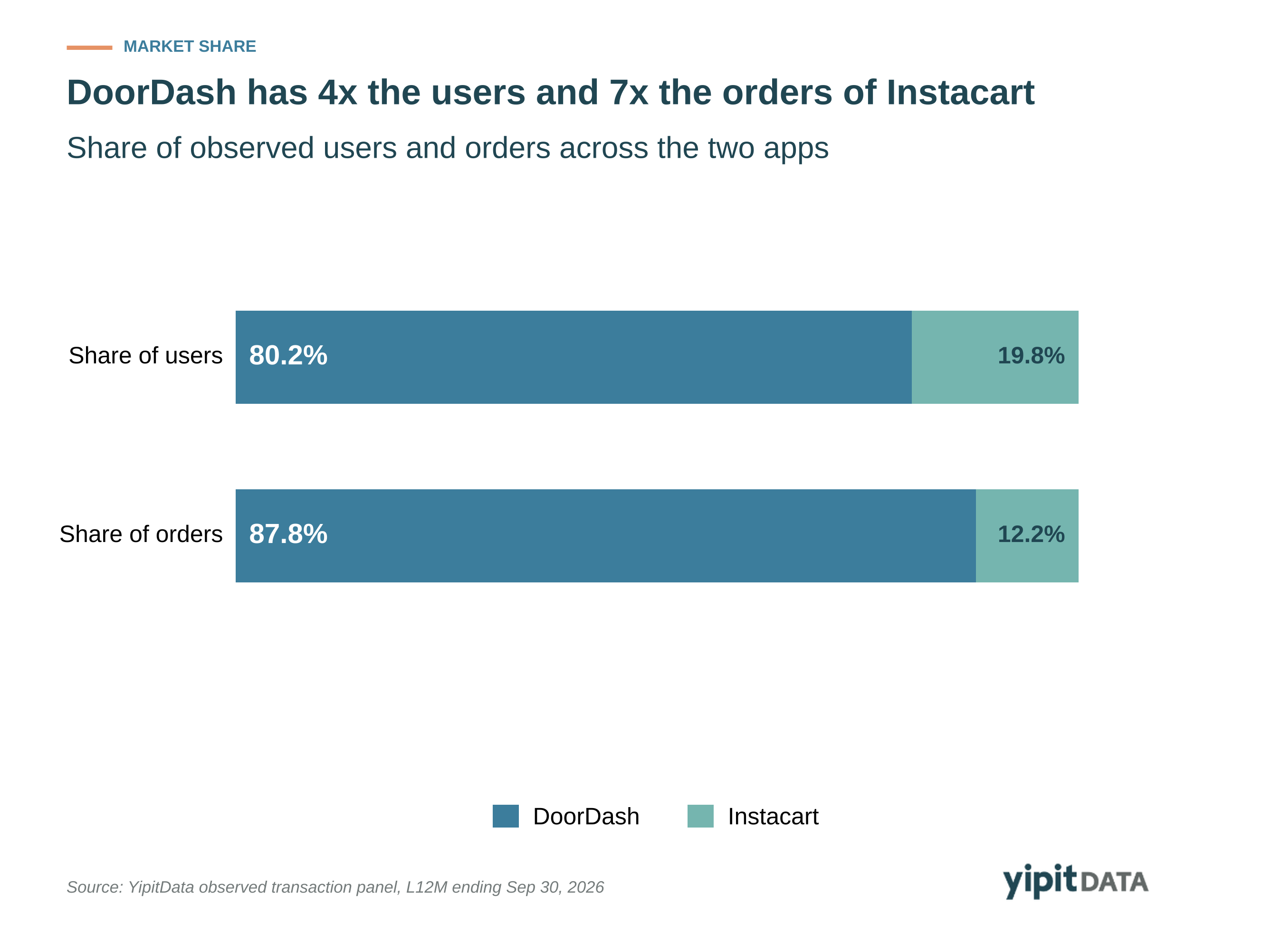
Add Uber Eats and the picture holds. DoorDash leads with 55.3% of users and 65.1% of orders, Uber Eats takes 31.1% of users and 25.8% of orders, and Instacart is the smallest of the three at 13.6% of users and 9.1% of orders. Combined, DoorDash and Instacart would account for roughly 69% of users and 74% of orders in our panel, which is why analysts expect the deal to draw antitrust review (CNBC).

Scale isn't what DoorDash is buying. It already has it.
Who wins grocery-sized orders?
Instacart, still. We use orders over $100 as a proxy for a full grocery basket. Instacart's share of those orders was 67.3% in October 2025 and 63.0% in September 2026. DoorDash went from 32.7% to 37.0% over the same period, a gain of about 4 points.
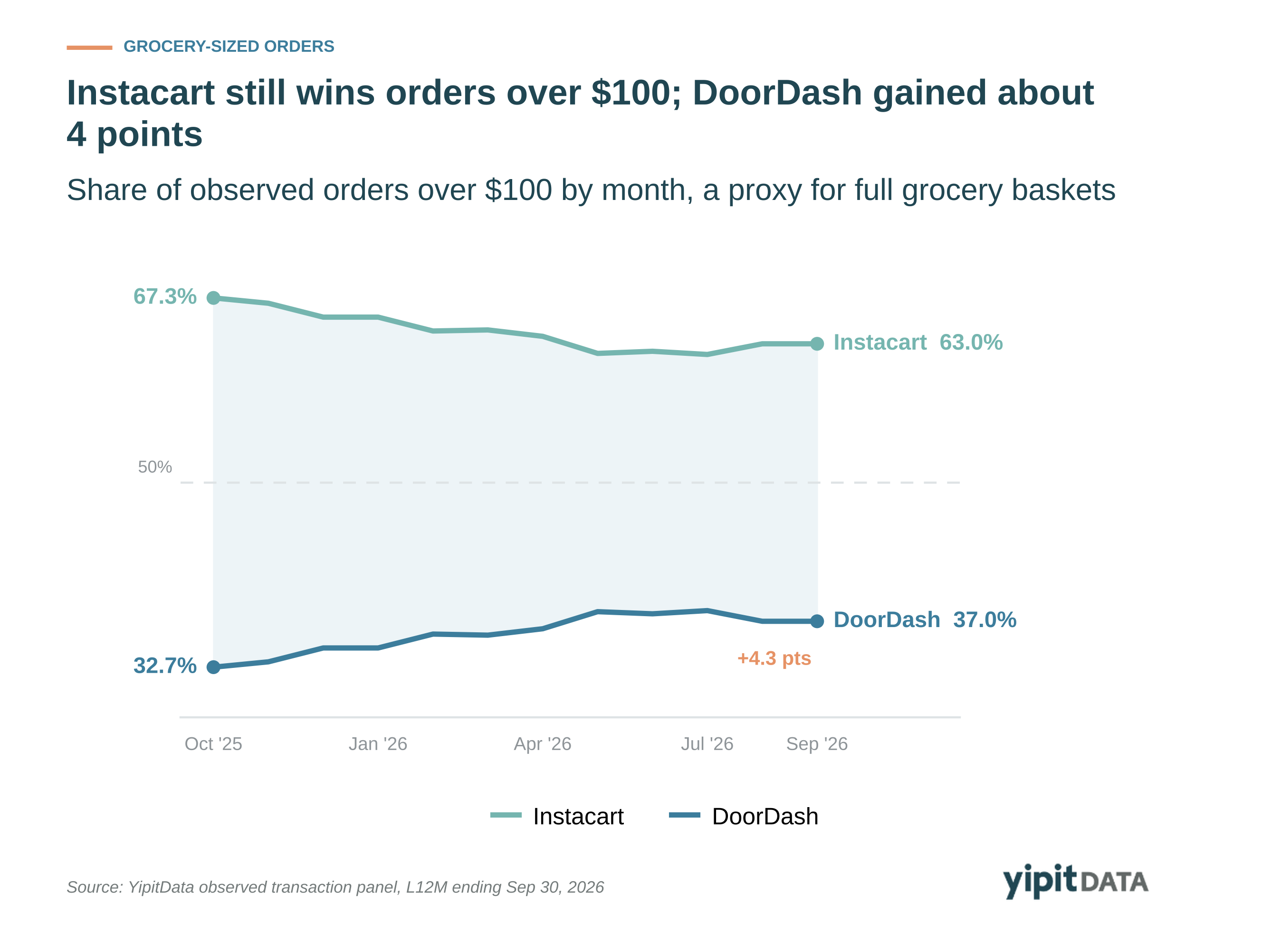
Two things are true at once. DoorDash has been taking share in large baskets on its own, which tells you grocery is a priority. And it is still losing that category to Instacart by nearly two to one, in a market where it is the larger app by every other measure. That gap is the acquisition case.
Instacart's average order is 3x DoorDash's
The average observed Instacart order is $99.30. The average DoorDash order is $35.98. That's the difference between a weekly grocery run and a restaurant meal.
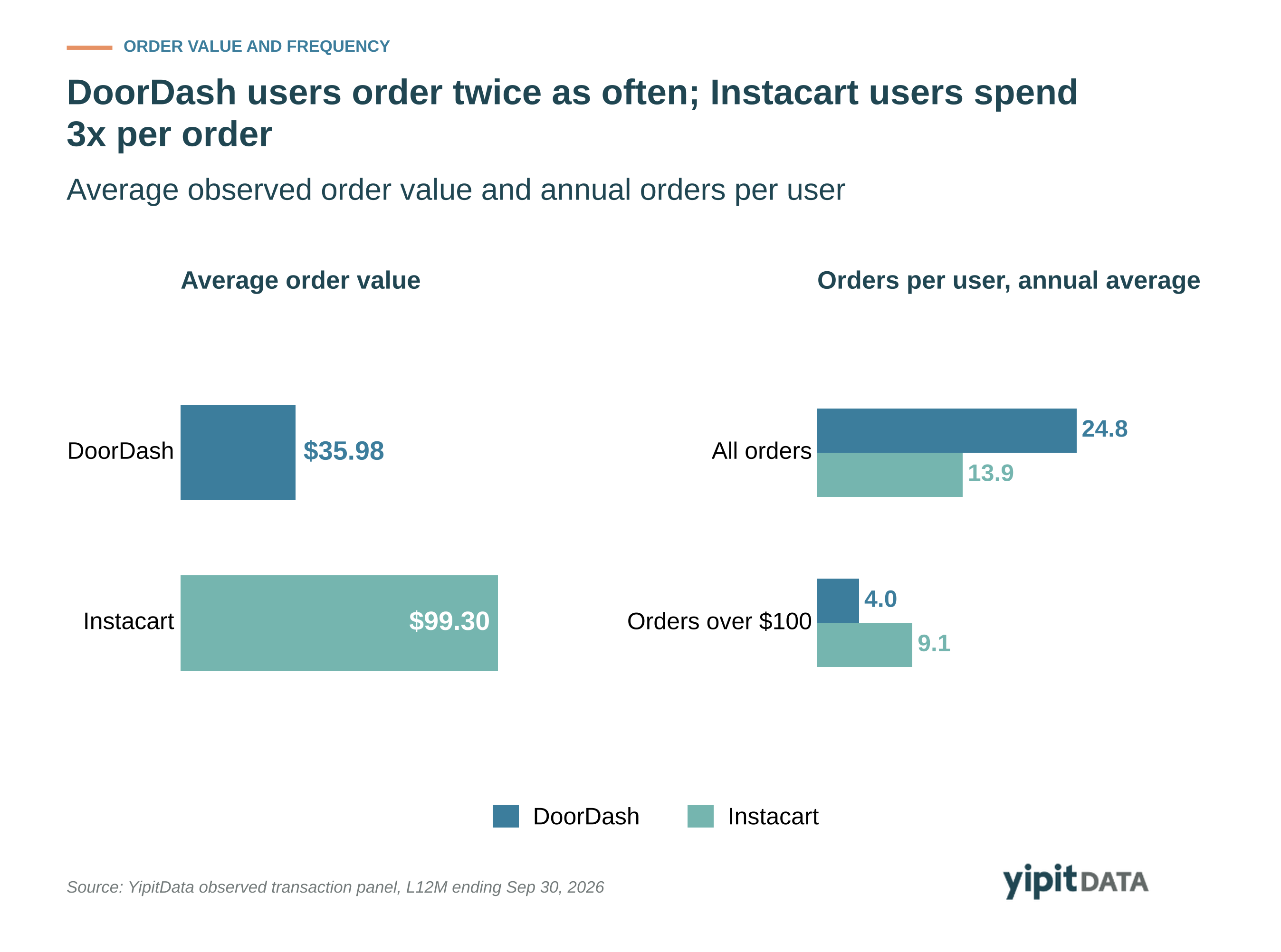
Frequency cuts the other way. The average DoorDash user placed 24.8 orders over the last 12 months, about twice a month, compared with 13.9 for the average Instacart user. But on orders over $100, Instacart users averaged 9.1 a year while DoorDash users averaged 4.0.
Put those together and the trade-off is clear. DoorDash's customer shows up more often and spends less. Instacart's customer shows up less often, spends about three times as much per order, and is the one you want when the goal is grocery.
What DoorDash gains, in one list
- A grocery customer base it hasn't built itself. Instacart holds 63% of orders over $100 despite being the smaller app.
- Higher-value orders. $99.30 per order versus $35.98.
- A customer who buys groceries online as a habit. 9.1 orders over $100 per user per year, more than double DoorDash's 4.0.
- Grocer relationships and enterprise tech. DoorDash says it will keep Instacart's retailer-facing products, including its advertising business (TechCrunch).
Methodology
All figures come from YipitData's observed transaction panel for the 12 months ending September 30, 2026 (October 2025 through September 2026). Shares are calculated within the observed panel and are not scaled to the full market; use the percentages rather than the underlying counts. "Orders over $100" is used as a proxy for grocery-sized baskets.
A note on scope. This post is a standalone analysis prepared for general readers. It does not represent findings from YipitData’s investor products, and the figures here were not produced using the methodologies behind those products. The underlying e-receipt panel is primarily a consumer panel, so enterprise and business spend (for example, corporate accounts or bulk orders placed through either platform) is underrepresented in these figures.
YipitData is a market intelligence company that turns real-world consumer and business spend into decision-ready intelligence for institutional investors, retailers, and consumer brands. To track DoorDash, Instacart, and the delivery category between earnings, talk to our team.
Sources
Frequently Asked Questions
Why is DoorDash buying Instacart?
To accelerate its push into grocery delivery. DoorDash already leads in restaurant delivery, but Instacart still wins about 63% of grocery-sized orders (over $100) and its average order is nearly 3x DoorDash's, according to YipitData's observed transaction panel.
How much is DoorDash paying for Instacart?
About $17 billion in equity value, or $65 per Instacart share, at least 75% in cash. The agreement was announced October 29, 2026 and is subject to regulatory approval.
Is DoorDash bigger than Instacart?
Yes. In YipitData's panel, DoorDash has roughly 4x Instacart's users and 7x its orders over the 12 months ending September 2026.
Will Instacart still exist after the acquisition?
DoorDash says it will keep the Instacart brand, app, and enterprise technology products.


