Adidas World Cup 2026 Strategy: How Licensed Soccer Apparel Is Driving Growth

.png)
As the 2026 FIFA World Cup drives record consumer engagement, Adidas soccer apparel sales in the U.S. have shifted toward licensed products. This report examines which teams and channels are driving growth, how kit launches reshape demand, and what the shopper profile of Adidas licensed soccer buyers reveals about cross-brand dynamics.
Key Takeaways
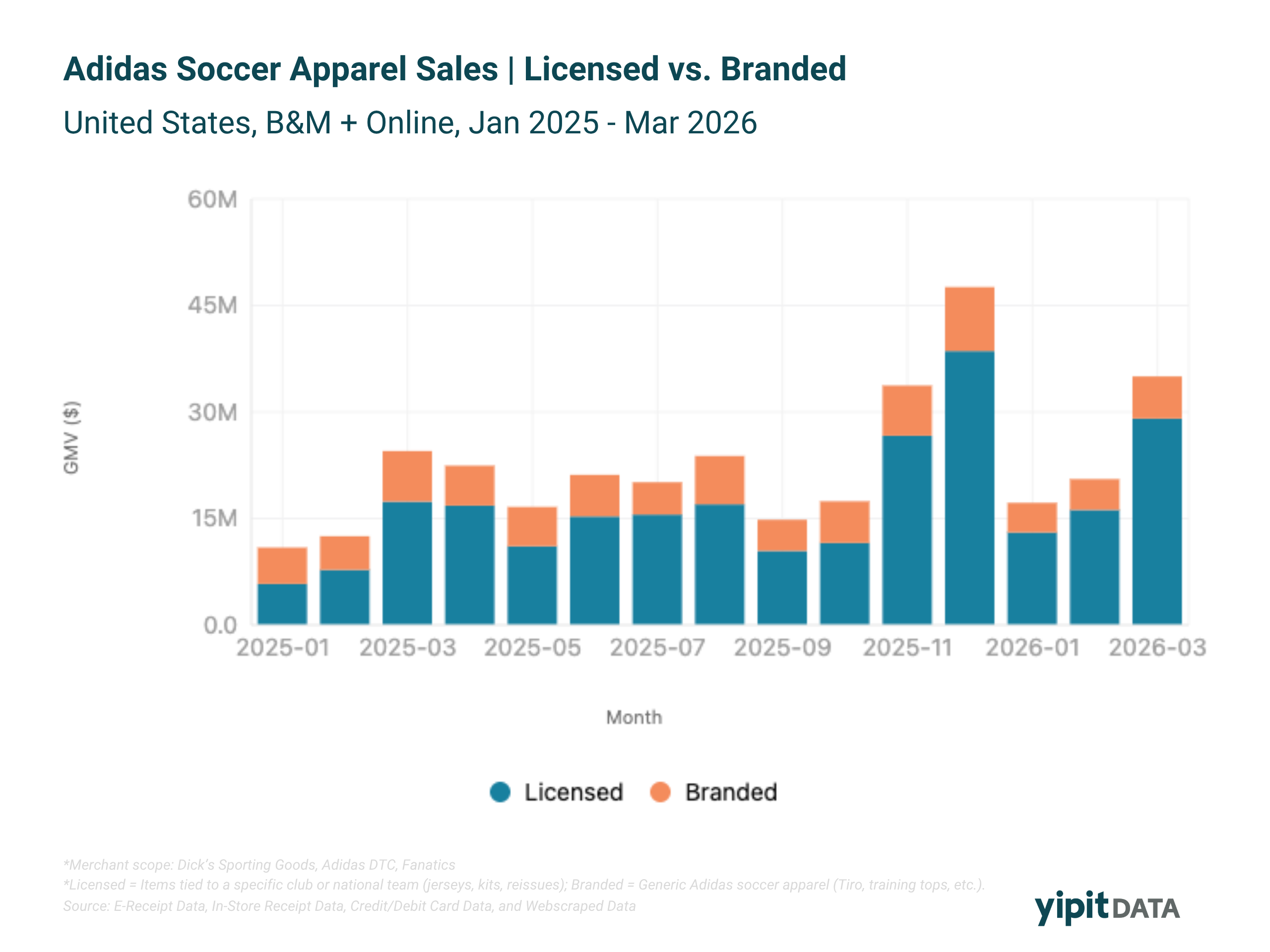
- Licensed Adidas soccer apparel grew from 53% of category sales in January 2025 to 83% in March 2026, while branded soccer apparel sales declined 22% YoY.
- Mexico accounted for 55% of Adidas national team licensed sales over the trailing twelve months, growing 59% YoY.
- The November 2025 World Cup 2026 kit launch shifted demand from club products to national teams, with national team share rising from 2% in October 2025 to 57% in November 2025.
- Adidas licensed soccer buyers at Dick's Sporting Goods over-indexed toward Nike in their broader apparel spending, signaling cross-brand reach.
The Shift Toward Licensed Soccer Apparel
Adidas soccer apparel growth in the U.S. is increasingly concentrated in licensed products. Jerseys and kits tied to specific clubs and national teams are outpacing generic branded soccer apparel such as Tiro training wear.
Between January 2025 and March 2026, licensed products rose from 53% to 83% of Adidas soccer apparel sales across Dick's Sporting Goods, Adidas DTC, and Fanatics. During the same period, licensed apparel sales grew 42% YoY, while branded soccer apparel sales declined 22% YoY.
The data suggests that consumers are shifting spend toward products with team affiliation rather than general-purpose training gear. The approaching FIFA World Cup 2026 has accelerated this trend.
How the World Cup 2026 Kit Launch Reshaped Demand
National Team Sales Surged After Kit Drops
Prior to the November 2025 World Cup 2026 home-kit launch, Adidas licensed soccer sales were heavily weighted toward club products. Clubs accounted for 77 to 97% of licensed sales from January through October 2025, with Real Madrid leading club-level demand.
The kit launch changed that composition almost overnight. National teams' share of licensed sales rose from 2% in October 2025 to 57% in November 2025. The data indicates that the kit release expanded consumer engagement beyond club franchises and toward national team products. This pattern is consistent with Adidas's staggered launch strategy of releasing home kits in late 2025 and away kits in March 2026 to create multiple demand waves.
Mexico Remains the Largest National Team Franchise
Among Adidas national team products sold in the U.S., Mexico was the clear leader. It accounted for 55% of trailing twelve-month national team licensed sales and grew 59% YoY.
This is consistent with Mexico's position as a World Cup 2026 co-host. The data shows that Mexico's outsized share held even as other national teams, including Argentina, Colombia, and Germany, gained contribution following the November kit launch. This indicates broader engagement across Adidas's national team portfolio.
Adidas Licensed Soccer Is Reaching Cross-Brand Shoppers
One of the more notable findings involves the shopper profile of Adidas licensed soccer buyers at Dick's Sporting Goods.
These buyers over-indexed toward Nike in their broader apparel spending: their prior-year wallet share was 19% Nike versus 16% Adidas. Despite this Nike-leaning spend pattern, soccer apparel purchases remained heavily concentrated toward Adidas licensed products at 91% of category spend versus 4% for Nike.
Nike also had the highest same-basket apparel attach rate at 10%, meaning Adidas licensed soccer products frequently appeared in orders alongside Nike apparel purchases. The data suggests that Adidas's licensed soccer products are resonating with shoppers who would otherwise index more heavily toward Nike, expanding Adidas's reach into a broader consumer base.
.png)
What This Means for the Soccer Apparel Market
The data points to several dynamics shaping the U.S. soccer apparel landscape heading into World Cup 2026:
- Licensed products are where the growth is. Generic branded soccer apparel (training tops, warm-up gear) is declining while club and national team licensed products grow. For retailers, this suggests inventory and assortment strategies should lean into licensed SKUs.
- Major event kit launches create meaningful demand shifts. The November 2025 kit launch didn't just add incremental sales. It fundamentally reshifted the mix from club to national team products. Brands and retailers anticipating similar dynamics for away-kit drops and tournament-time restocks can plan accordingly.
- Mexico is a high-value franchise in the U.S. market. With 55% of national team sales and 59% YoY growth, Mexico's position as a co-host is translating into outsized commercial performance.
- Cross-brand shopper dynamics create opportunity. Adidas licensed soccer products are attracting Nike-leaning shoppers, suggesting that licensed sports products can serve as an acquisition channel for brands seeking to expand their consumer base.
Methodology
This analysis is based on YipitData's e-receipt data, credit/debit card data, and web-scraped data covering Dick's Sporting Goods, Adidas DTC, and Fanatics. Licensed products are defined as items tied to a specific club or national team (jerseys, kits, reissues). Branded products refer to generic Adidas soccer apparel (Tiro, training tops, etc.). Data covers the period from January 2025 through March 2026 in the United States, including both brick-and-mortar and online channels.
For more data-driven insights on apparel and footwear trends, explore YipitData's Apparel & Footwear research.
.svg)
Speak to our Insights team


.svg)