Is AI Reducing Demand for Project Management Software? New Data on Asana, Atlassian, and monday.com


.webp)
New YipitData analysis of 730 companies shows AI leaders are cutting project management software spend. See what the data reveals for Asana, Atlassian, and monday.com.
New Signals data from 730 companies shows AI leaders are reallocating software budgets away from project management tools, with consistent declines across Asana, Atlassian, and monday.com.
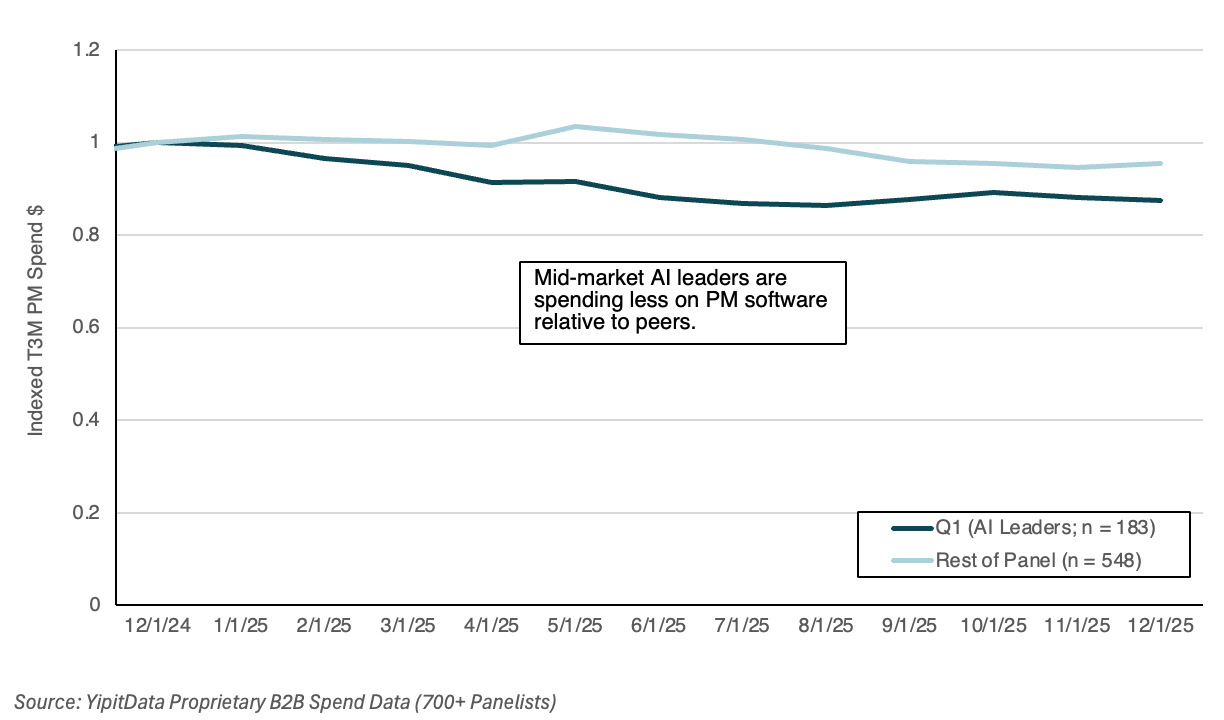
Across the entire project management category, mid-market companies leading AI adoption are reducing their share of spend on PM tools relative to peers.
That’s the story we found based on YipitData's Signals data, which tracked 730 companies through early 2026. The pattern is clear: The most AI-intensive organizations are consistently reducing project management software both on a total $ basis and as a share of their total software budgets, while the lowest AI adopters are moving in the opposite direction.
Here's what the data shows.
Revisiting the Data With a Broader Definition of AI Adoption
Last week, we explored a simple question: Are companies that are adopting AI starting to trim spend on traditional SaaS tools?
AI’s impact on project management software (Asana, Atlassian, and monday.com) sparked the most discussion.
You asked:
- How are we defining AI early adopters?
- How do the trends look for Asana, Atlassian, and monday.com individually?
- Could the results be skewed by panelists entering and leaving the dataset?
To address these questions, we revisited the analysis with a revised methodology and a broader dataset.
In our earlier analysis, we focused on a relatively small cohort of companies we described as AI early adopters. This group consisted of roughly thirty-five mid-market companies with outsized and rapidly growing spending on a set of core AI vendors including OpenAI, Anthropic, Anysphere, Cohere, Mistral AI, Together AI, Fireworks AI, Hugging Face, Scale AI, Midjourney, ElevenLabs, Stability AI, and Perplexity.
Although multiple vendors were included in this group, the majority of spending was concentrated in OpenAI, reflecting the dominant role of large language models in early AI adoption. (See what 851 teams actually pay for OpenAI.)
For the updated analysis, we expanded the scope significantly. Rather than isolating a small cohort of AI-intensive companies, we ranked the entire mid-market panel based on AI spending as a percentage of total software budgets in December 2024.
Companies were then divided into four quartiles, creating a distribution that reflects varying levels of AI adoption across the dataset. The companies in the top quartile — roughly 180 organizations — represent the most AI-intensive companies in the panel. In this analysis, we refer to this group as AI leaders.
This broader methodology allows us to examine how spending patterns change across the full spectrum of AI adoption rather than focusing only on a narrow group of early adopters.
Ensuring Panel Stability
Another important adjustment to this week’s analysis involved controlling for potential panel volatility.
Spend datasets can change over time as companies enter or leave the panel. If not accounted for, those changes can sometimes produce misleading signals.
To eliminate this possibility, the analysis was restricted to a fixed group of approximately 730 companies that remained in the dataset throughout the full period being analyzed. By holding the panel constant, the results reflect actual changes in spending behavior rather than shifts in panel composition.
With this revised methodology in place, we then examined how project management software spending changed across the four AI adoption quartiles.
AI Leaders Are Pulling Back on Project Management Software
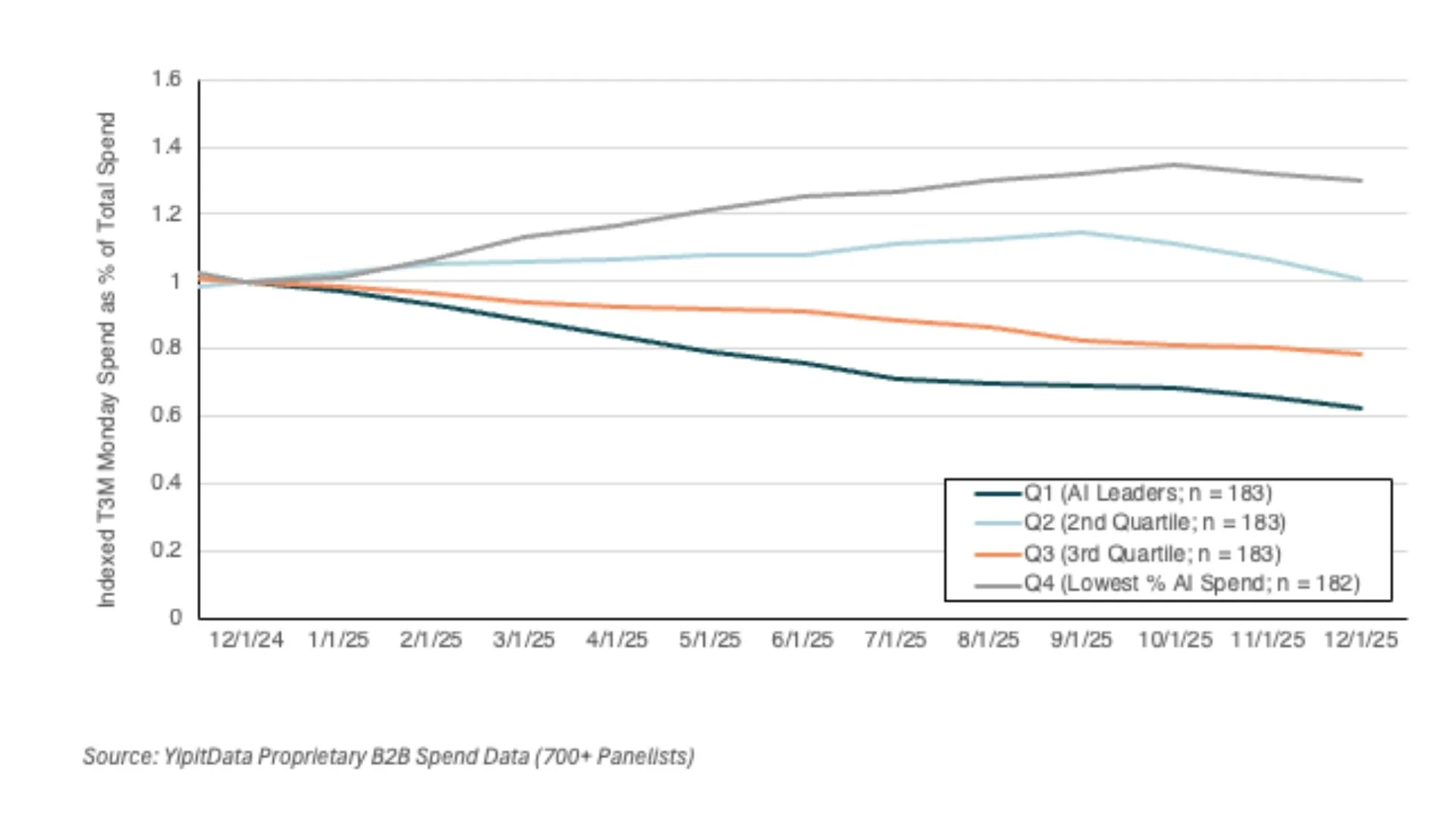
The new methodology confirms the takeaway from last week: Companies leading in AI adoption appear to be reducing their share of spending on project management software relative to peers.
When looking at the data across the entire project management category, the divergence becomes visible beginning in early 2025.
Companies in the top quartile of AI adoption show a noticeable decline in project management spending both on a total $ basis and as a percentage of total software budgets. In contrast, companies in the lowest quartile of AI spending show the opposite trend — their allocation toward project management tools increases over the same period.
This suggests that organizations investing aggressively in AI may be reallocating budgets toward AI platforms and away from certain traditional SaaS categories.
A More Nuanced Pattern Across the Distribution
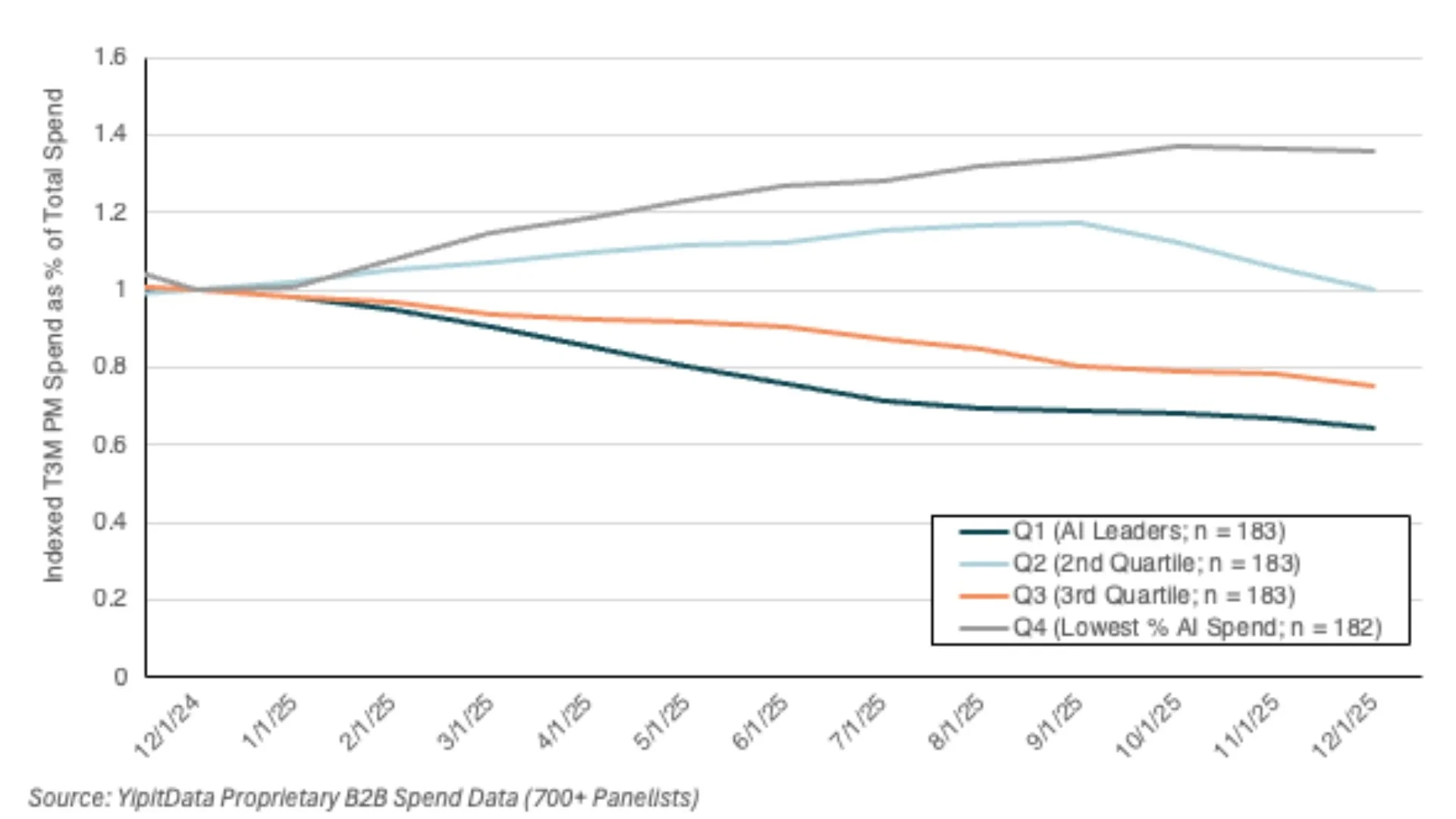
While the contrast between AI leaders and the lowest AI adopters is relatively clear, the pattern becomes less straightforward when examining the middle of the distribution.
Companies in the second quartile of AI adoption actually show an increase in project management spending over the same period. Meanwhile, companies in the third quartile exhibit a modest decline.
This mixed pattern suggests that the relationship between AI adoption and project management spending does not progress in a perfectly linear way across all companies.
Instead, the strongest signal appears when comparing the most AI-intensive companies either with the lowest adopters or with the rest of the panel overall.
Breaking it down: Asana vs Atlassian vs monday.com
To better understand the category dynamics, we also examined spending trends for the three largest project management vendors in the dataset: Asana, Atlassian, and monday.com.
The results show that the pattern is not isolated to a single vendor, though the timing and magnitude of the divergence vary slightly across platforms.
Asana Shows the Earliest Divergence
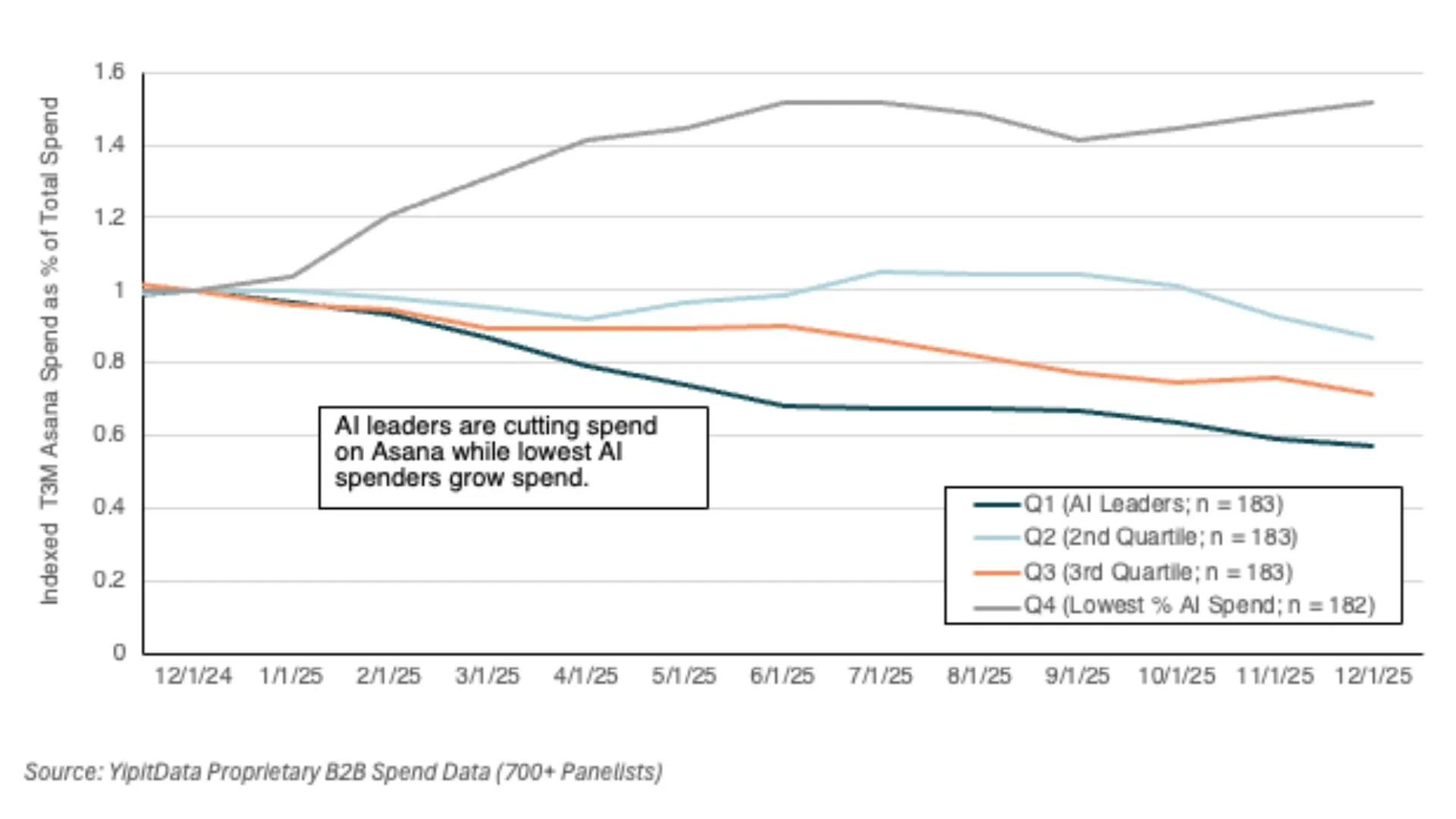
Among the three vendors, the divergence between AI leaders and other companies appears earliest in Asana’s data.
Beginning in early 2025, companies with the highest AI spending begin reducing Asana spending as a share of their total software budgets. At the same time, companies with the lowest AI spending continue expanding their share of spending on the platform.
This creates a clear separation in spending behavior between AI-intensive organizations and companies with lower AI adoption.
(See what real companies are spending for Asana in 2026.)
Atlassian Shows a Similar Pattern
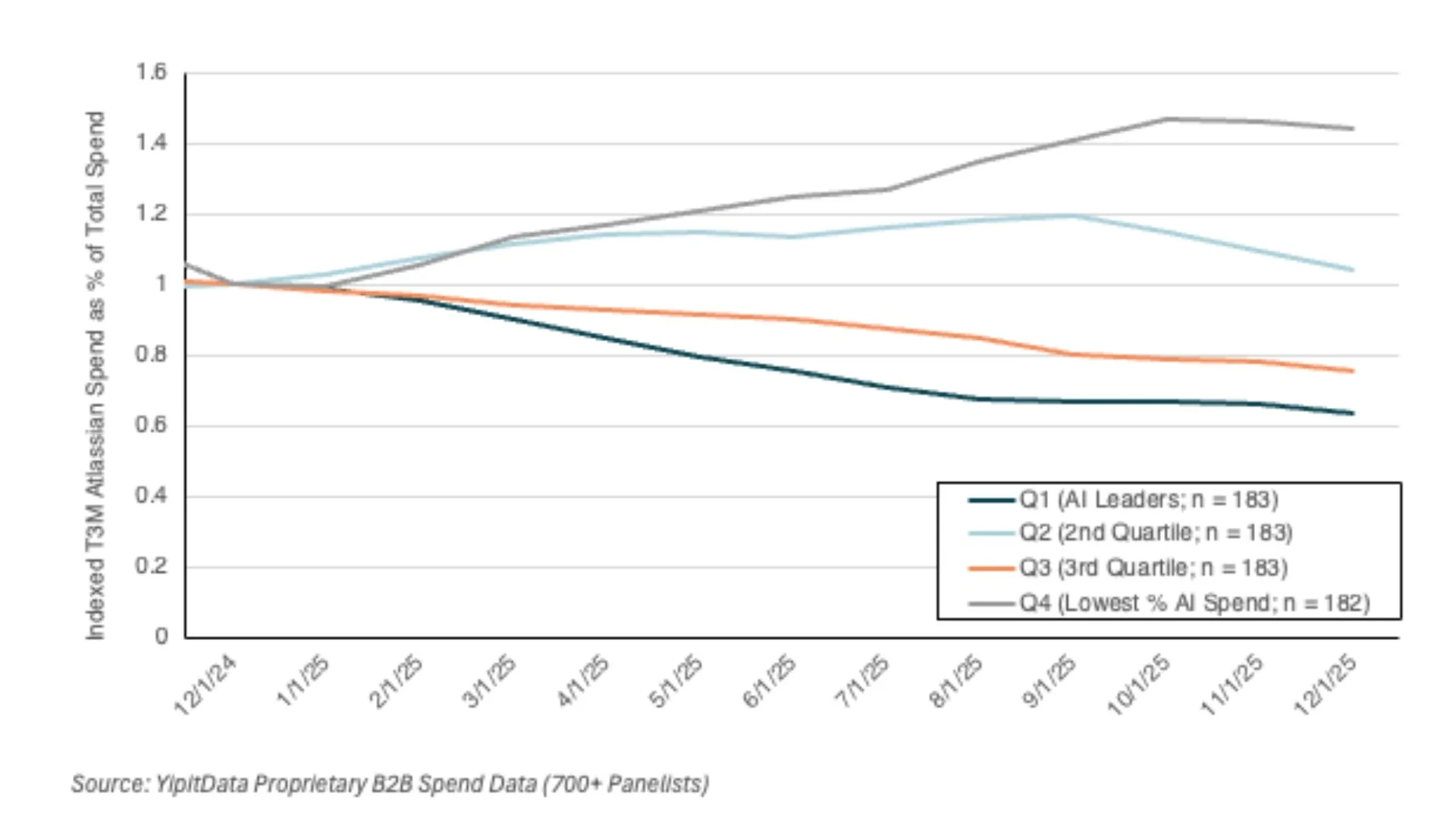
The pattern for Atlassian broadly mirrors what we observe with Asana. Companies leading in AI adoption show declining spending share on Atlassian products, while companies with lower AI investment show steadier or increasing demand.
Although the timing of the divergence is slightly different, the direction of the trend is consistent with the broader category signal.
(See what real companies are paying for Atlassian in 2026.)
monday.com Shows a More Moderate Divergence
For monday.com, the pattern appears somewhat more moderate but still directionally similar.
AI leaders again show declining spend share relative to peers, though the gap between AI leaders and the rest of the panel is smaller compared with the divergence observed for Asana and Atlassian.
(See what real companies are paying for monday.com in 2026.)
What Growing AI Spend Means for SaaS Budgets
Signals data suggests that AI adoption may reshape how companies allocate software budgets.
Project management software appears to be one of the first categories where this shift is becoming visible. But the mixed results across the middle quartiles indicate that the relationship between AI adoption and SaaS spending is nuanced and would benefit from further investigation.
Factors such as company size, workflow complexity, engineering maturity, and the specific ways companies deploy AI internally will likely influence how budget reallocations play out over time.
What other software companies are at risk as AI adoption accelerates?
FAQ’s
- Are companies replacing project management tools with AI?
- YipitData's Signals data shows that mid-market companies leading in AI adoption are reducing total $ as well as their share of project management software spending — but the picture is nuanced. The decline appears to reflect budget reallocation toward AI platforms rather than outright cancellation of project management tools. Notably, the trend is specific to mid-market AI leaders; at the enterprise level, the data shows the opposite pattern, with AI-intensive companies actually expanding project management spend relative to peers (see our analysis from last week here).
- Is AI spend growth coming at the direct expense of project management software?
- For mid-market companies, the data suggests a meaningful correlation. YipitData's earlier analysis on whether AI is replacing sSoftware found that mid-market AI early adopters cut project management software spending allocation by approximately 50% year-over-year by December 2025, while the rest of the mid-market panel cut allocation by around 20%. Over the same period, AI early adopters increased core AI spend by more than 300%, compared to roughly 120% for the rest of the panel — pointing to an active budget shift rather than an across-the-board SaaS reduction.
- Which project management vendors are being most impacted by AI-related budget reallocation?
- Among the three vendors analyzed, Asana shows the earliest and clearest divergence — AI-intensive mid-market companies began reducing their share of Asana spending in early 2025 while lower-AI-adopters continued expanding theirs. Atlassian shows a similar directional pattern with slightly different timing. monday.com shows the same trend but with a more moderate gap between AI leaders and the rest of the panel. The consistency across all three vendors suggests this is a category-level shift rather than a problem specific to any one platform.
- What other SaaS categories might face similar budget pressure as AI adoption grows?
- Project management software is one of the first categories where the reallocation signal is becoming visible in YipitData's data, but it’s unlikely to be the last. Categories where AI tools can meaningfully replicate core functionality — such as certain customer support, content creation, and workflow automation tools — are likely to face the most scrutiny at renewal time. As a reference point, Gartner estimated companies spent nearly $1.5 trillion on AI in 2025, making AI a mandatory budget priority that puts pressure on every other line item in the software stack to justify its place.
- How does YipitData define "AI leaders" in this analysis?
- For this analysis, YipitData ranked its entire mid-market panel by AI spending as a percentage of total software budgets in December 2024, then divided companies into four quartiles. The top quartile — roughly 180 organizations — represents the most AI-intensive companies and is referred to as AI leaders. This is a broader definition than an earlier YipitData analysis, which focused on a narrower cohort of approximately 35 companies with outsized spending on a core set of AI vendors including OpenAI, Anthropic, and Anysphere.
- Where does YipitData's software spend data come from?
- The insights in this analysis are derived from YipitData's Signals platform, which aggregates anonymized software spending data from companies that share ERP-sourced transaction data with YipitData or through enterprise data partnerships. The platform tracks spending and adoption trends across hundreds of mid-market and enterprise companies and more than 250,000 software vendors.
.svg)
Connect with us!


.svg)