The Reality of Cloud Pricing in B2B Markets
By Nick Shields, Senior Manager - Corporate Tech Growth @ Yipitdata
Let's face it — pricing strategy in B2B end markets is hard. Unlike the consumer markets, companies can't simply pull up a website to see what competitors actually charge.. Even when businesses do list prices publicly — hyperscalers are famous for posting thousands of instance prices, for example — those figures rarely reflect realized enterprise pricing after discountings and negotiated contracts.
So where have decision makers turned? Surveys help on margins but are prone to sample and response biases. Expert networks can surface SMEs on the topic, yet face many of the same limitations. Drawing clear, actionable pricing insights from traditional sources remains a major challenge.
YipitData changes that dynamic. We analyze over $25 billion in annual spend on Cloud, software, and AI services enabling visibility into seat-based pricing, direct consumption trends — at a token and per-hour level — and more. These granular insights help customers make informed decisions around pricing, procurement, infrastructure, and competitive positioning.
Cloud
For several years YipitData has maintained one of the industry's most comprehensive Cloud spending datasets. Customers rely on it for two primary reasons:
The sheer volume of spending. We analyze more than $20 billion in annualized CSP spend across AWS, Azure, GCP, and OCI. To put that in perspective — that's more than 9% of spend on AWS, 6% on Azure, 6% on OCI, and ~4% on GCP.
The granularity to make critical business decisions. Our data comes directly from the cost management platforms, with visibility down to a product, model, and hardware level for each customer in the dataset. We can also separate pricing from usage — helping clients understand whether revenue inflections stem from price increases or actual spikes in consumption.
GPU Pricing: a quick case study
GPU pricing has become one of the most important topics in enterprise infrastructure.GPUs excel at LLM workloads because their parallel architecture is optimized for the matrix multiplications that dominate transformer training and inference — making GPU compute instances a necessary building block for AI itself.
As a result, demand for renting GPUs within Cloud datacenters has skyrocketed, pushing pricing higher with little sign of the trend abating. And this is an area where pricing decision makers still frequently rely on the publicly posted list prices from the CSPs.
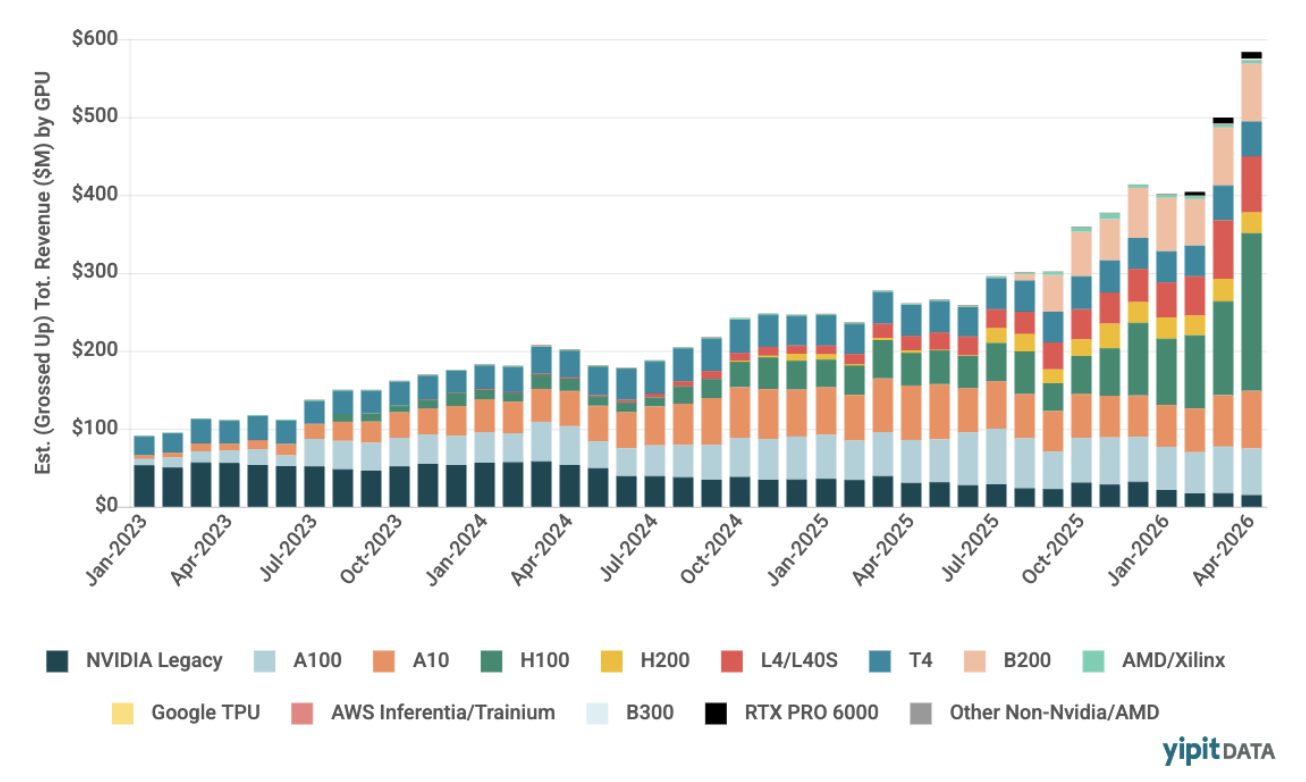
Within our Cloud dataset, we go one step further — parsing out realized invoice pricing for renting GPUs. Not what is advertised to prospective customers, but what is actually paid — for specific GPU models, down to a per-hour, per-GPU basis.
What have we seen recently? Since mid-2025, per-hour per-GPU pricing has been steadily rising for both AWS and Azure. However, as the chart below shows, the pace of increases has been accelerating for Azure over the last two months, with pricing now just shy of $1.50 per hour per GPU.
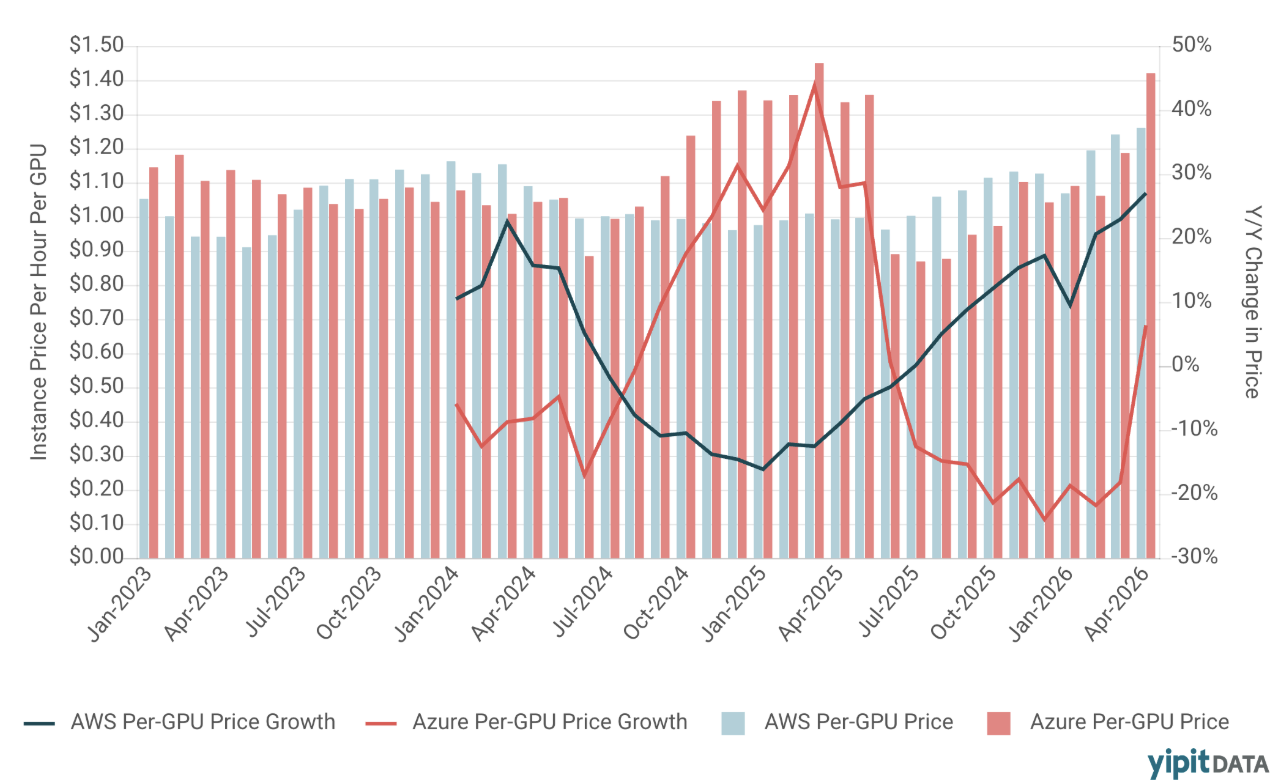
We can go even further — comparing GPU pricing differences across CSPs to inform decisions about which cloud provider to use for specific AI workloads. For organizations deploying LLM workloads or pricing GPU infrastructure, understanding pricing differences across CSPs has become table-stakes intelligence.
The Bottom Line
B2B pricing has historically been a black box — but it doesn't have to be. With over $20 billion in observed Cloud spend and the granularity to break it down by provider, GPU model, and realized invoice price, YipitData gives decision makers the clarity they need to move beyond list prices and gut instinct. If you're navigating Cloud pricing decisions today, we'd love to show you what our data can do. Stay tuned for the next installments in this series on B2B SaaS and Frontier Model pricing — and don't hesitate to reach out to me at nshields@yipitdata.com in the meantime.